- 导读
锌空气电池凭借其高理论能量密度、低原料成本、良好安全性与环境友好性,在大规模储能、特种电源及柔性电子设备等领域具有广阔应用前景。然而,传统水系电解液体系在宽温区条件下存在严重性能瓶颈:低温下离子电导率骤降、氧反应动力学迟缓;高温下锌负极腐蚀加剧、催化剂快速失活,严重制约了其在极端温度场景中的应用。过渡金属化合物如层状V₂O₅和ZnSe虽各具催化潜力,但受限于导电性差、稳定性不足或反应动力学不理想等问题。界面工程构建异质结可诱导电荷重分布与内建电场,有望加速离子迁移、优化中间体吸附能并提升催化稳定性;同时,多元素掺杂碳载体可进一步协同增强导电性与活性位点分散性。然而,目前针对V₂O₅/ZnSe氧化物-硒化物异质结在宽温区锌空气电池中的电荷重分布机制及其对催化性能影响的研究尚属空白,亟需系统探索。
- 成果掠影
近日,莆田学院易明杰教授联合哈尔滨工业大学张嘉恒教授将离子液体作为多元素掺杂剂引入Zn-V-MOFs,经硒化合成ZnSe-V₂O₅异质结并包裹于N、P掺杂碳中(ZnSe-V₂O₅/NPC)来制备高性能宽温区锌空气电池。该样品具有以下优点:(1)异质结界面电荷重分布形成内建电场,协同多元素(N、P等)掺杂调控碳材料电子结构,改善电子传输环境,使活性位点均匀分散且利用率显著提升;(2)多元素掺杂碳的高导电性弥补了V₂O₅导电性差的缺陷,加速界面电荷转移、降低传输阻力,同时诱导额外活性中心,协同异质结强化催化活性并提升界面相容性;(3)V₂O₅/ZnSe的界面协同效应结合掺杂碳的稳定性调控,优化了ORR/OER中间体(OOH、O、*OH)的吸附-脱附自由能,使催化剂在宽温区内保持优异动力学特性。该研究为宽温区柔性锌空气电池电极材料设计提供了重要启示,其中ZnSe/V₂O₅异质结电荷重分布引发的优化机理,可拓展应用于其他氧化物/硒化物异质结体系,助力锌空气电池在极端温度条件下的实用化推广。
该成果以莆田学院为第一单位以题目“Interfacial charge redistribution at ZnSe/V2O5 heterojunction encapsulated in N, P-doped carbon enables high-performance wide-temperature Zn-air batteries”在国际顶级化学工程研究期刊Chemical Engineering Journal(中科院一区)上发表,影响因子为12.8。
三、核心创新点
本研究针对柔性锌空气电池难以适应宽温区极端环境的关键瓶颈,面向可穿戴与柔性储能实际应用需求,针对单一 V₂O₅电导率低、碱性稳定性差以及 ZnSe 本征 ORR/OER 反应动力学不足的材料缺陷,构建 ZnSe V₂O₅氧化物 硒化物异质结,依托异质界面电荷重分布诱发的内建电场调控离子输运行为与氧中间体吸附能,改善宽温区催化动力学与循环稳定性;进一步引入多元素掺杂碳载体实现协同改性,利用掺杂碳优异的导电网络、多孔结构与电子调控效应弥补单一异质结在高电流及极端温度下的结构稳定性短板,系统探究该异质结复合材料的界面作用机制及其对宽温区柔性锌空气电池电化学性能的调控规律,为极端温度条件下柔性锌空气电池高性能电催化剂的设计与实用化开发提供新的思路与实验依据。
四、数据概览
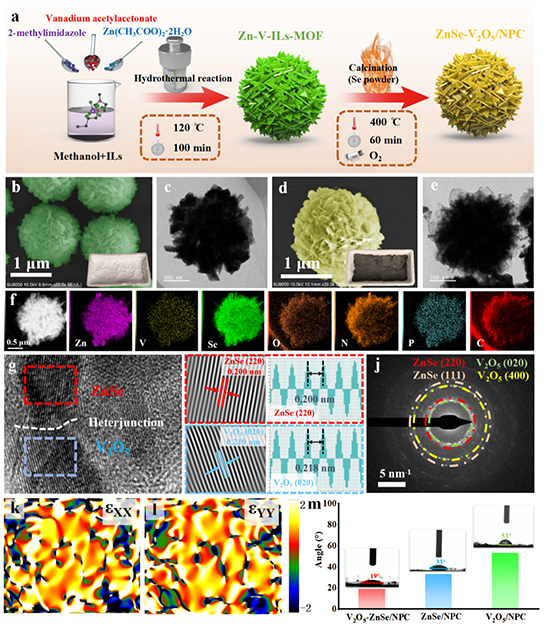
Fig. 1. (a) The illustration of the preparation process of ZnSe-V2O5/NPC. (b) SEM and (c) TEM images of Zn-V-ILs-MOF. (d) SEM and (e) TEM images of ZnSe-V2O5/NPC. (f) The mapping of ZnSe-V2O5/NPC. (g) HRTEM image, (l) inverse FFT lattice image, (m) lattice spacing, and SAED diffraction pattern of ZnSe and V2O5 in ZnSe-V2O5/NPC. (k, l) GPA analysis of ZnSe-V2O5/NPC. (m) The water contact angles of ZnSe-V2O5/NPC, ZnSe/NPC, and V2O5/NPC.
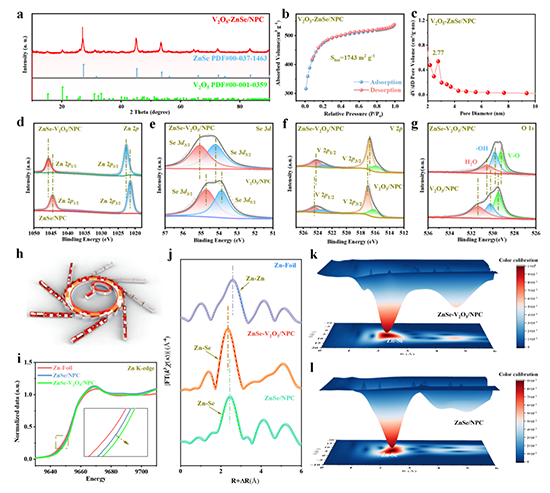
Fig. 2. (a) X-ray diffraction (XRD) patterns of ZnSe-V2O5/NPC. The (b) specific surface area and (c) Pore size distribution of ZnSe-V2O5/NPC. XPS peaks of (d) Zn 2p, (e) V 2p, (f) Se 3d and (g) O 1s for ZnSe-V2O5/NPC. (h) Schematic diagram of synchrotron radiation. (i) XANES spectra and (j) the corresponding FT EXAFS data at Zn K-edge for Zn foil, ZnSe-V2O5/NPC, and ZnSe/NPC. WT EXAFS plots at the Zn K-edge for (k) ZnSe-V2O5/NPC and (l) ZnSe/NPC.
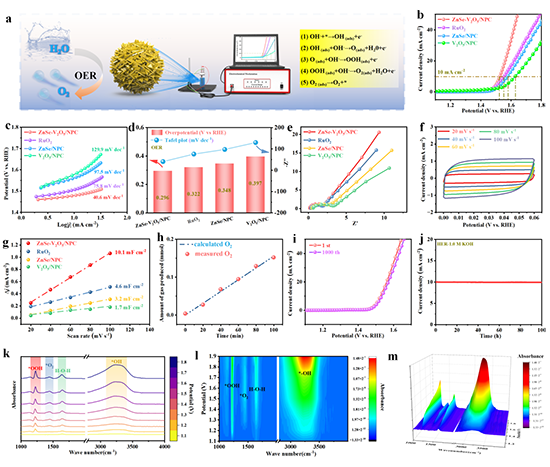
Fig. 3. (a) Schematic diagram of the OER principle and testing. (b) Polarization curves in OER of ZnSe-V2O5/NPC, RuO2, ZnSe/NPC, and V2O5/NPC. (c) Tafel plots derived from the panel. (d) Comparison of overpotentials and Tafel slopes. (e) The EIS of ZnSe-V2O5/NPC, RuO2 ZnSe/NPC, and V2O5/NPC. (f) CV curves and (g) relative electrochemically active surface area. (h) Amount of gas measured and calculated of the ZnSe-V2O5/NPC. (i) Polarization curves of before and after 1000th LSV tests and (j) the chronoamperometric stabilities of of the ZnSe-V2O5/NPC. (k) Spectra, (l) contour plots, and (m) 3D mapping plots of in-situ infrared spectroscopy testing.
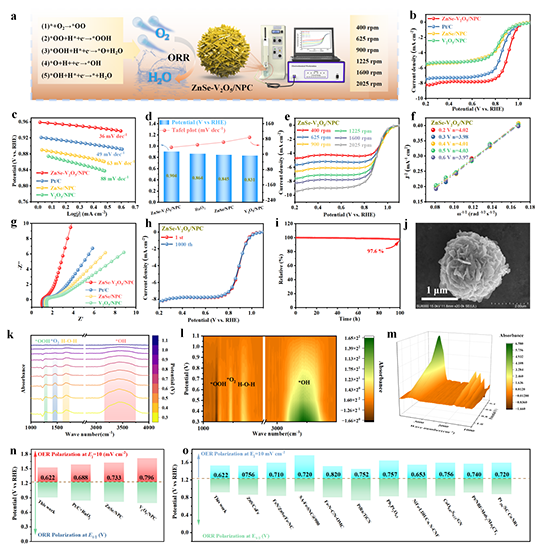
Fig. 4. (a) Schematic diagram of the ORR principle and testing. (b) Polarization curves in ORR of ZnSe-V2O5/NPC, Pt/C, ZnSe/NPC, and V2O5/NPC in 0.1 M KOH (rotating speed:1600 rpm). (c) Tafel plots derived from the panel. (d) Comparison of overpotentials and Tafel slopes. (e) LSV curves at different rotating speeds and (f) the corresponding Koutecky-Levich plots at different potentials. (g) The EIS of ZnSe-V2O5/NPC, Pt/C, ZnSe/NPC, and V2O5/NPC. (h) Polarization curves before and after 1000th LSVs tests. (i) The chronoamperometric stabilities of the ZnSe-V2O5/NPC in ORR. (j) SEM image after cycles. (k) Spectra, (l) contour plots, and (m) 3D mapping plots of in-situ infrared spectroscopy testing. (n) The overall polarization curves of catalysts within the ORR and OER potential window and the specific value. (o) Comparison of OER and ORR bifunctional activities in this work with representative electrocatalysts in references.
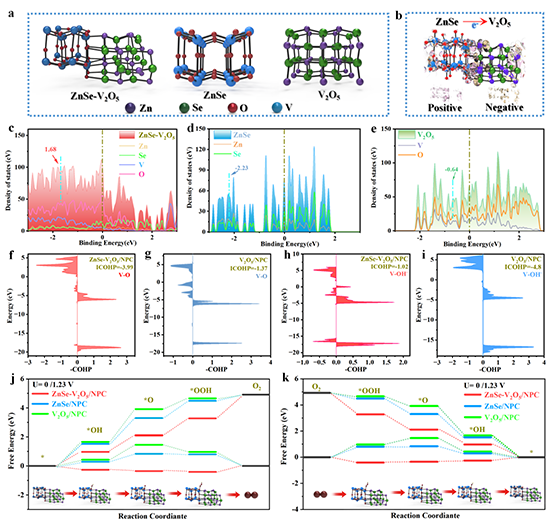
Fig. 5. (a) Side views of ZnSe-V2O5, ZnSe, and V2O5. (b) Electron density difference images of ZnSe-V2O5. Total density of states (TDOS) and d-bond centre data for (c) ZnSe-V2O5, (d) ZnSe, and (e) V2O5. The ICOHP of V-O in (f) ZnSe-V2O5 and (g) V2O5. The ICOHP of V-OH– in (h) ZnSe-V2O5 and (i) V2O5. The free energy diagram for the elementary reduction steps in (j) OER and (k) ORR.
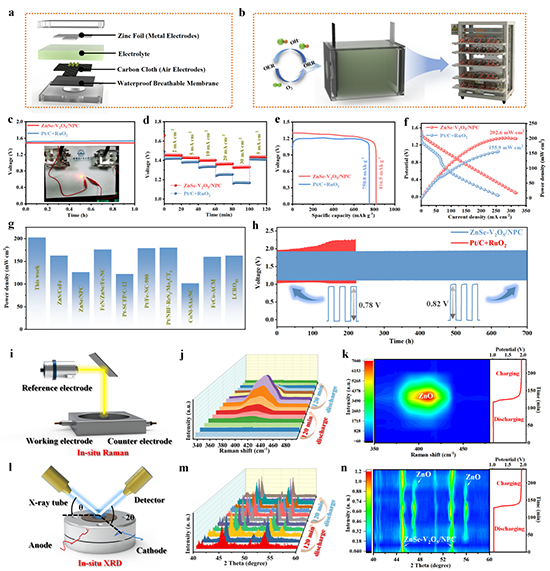
Fig. 6. (a) Schematic diagram of accessories for a Zn-air battery. (b) Schematic of testing for a Zn-air battery. (c) Open circuit potential curves (inset: Schematic diagram of application), (d) discharge rate performance, (e) discharge capacity, (f) polarization and power density curves of ZnSe-V2O5/NPC and Pt/C+RuO2. (g) Comparison to recent Zn-air battery power densities. (h) Galvanostatic discharge-charge cycling curves of ZnSe-V2O5/NPC and Pt/C+RuO2. (i) Setup diagram, (j) spectra, and (k) contour map of in-situ Raman testing. (l) Setup diagram, (m) spectra, and (n) contour map of in-situ XRD testing.
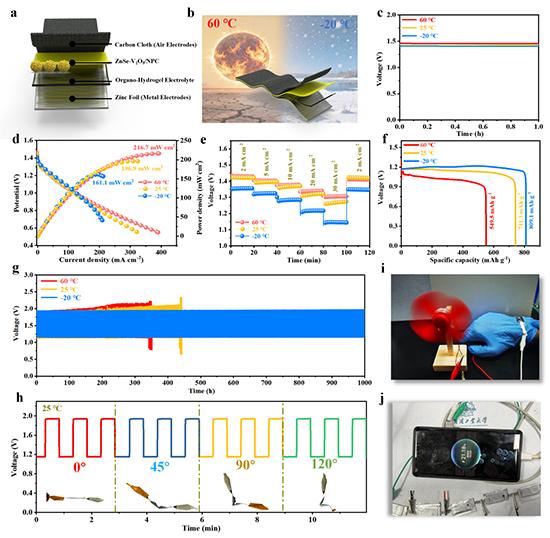
Fig. 7. (a) Diagram of the freestanding air cathode. (b) Schematic of a flexible Zn-air battery for a wide temperature range. (c) Open circuit potential curves, (d) Discharge polarization and power density curves , (e) discharge rate performance, (f) specific capacity, and (g) galvanostatic discharge-charge cycling curves of ZnSe-V2O5/NPC at different temperatures. (h) Charge-discharge under different bending states at 5 mA cm-2. (i, j) Image of charging by tandem devices.
五、成果启示
上述研究结果表明,通过构建氧化物 硒化物异质结并耦合多元素掺杂碳载体的协同改性策略,是突破柔性锌空气电池宽温区性能短板的有效途径。异质界面诱导的电荷重分布效应能够构筑内建电场,优化离子迁移行为与氧反应中间体吸附自由能,兼顾低温离子传输迟滞与高温界面失稳问题,同步提升 ORR/OER 双功能催化活性;而多元素掺杂碳不仅可以搭建高效导电网络、提供丰富孔道,还可进一步调控电子结构、强化界面相容性,缓解高电流密度与极端温度下活性物质团聚、体积膨胀与组分流失现象,弥补仅依靠异质结改性带来的结构稳定性不足。该工作揭示了 V₂O₅/ZnSe 异质结的界面作用机制,为过渡金属氧化物 硒化物基宽温区双功能电催化剂的理性设计提供理论参考,同时也为面向可穿戴电子、极端场景储能应用的柔性锌空气电池电极材料开发提供可行的实验思路。