- 导读
本研究针对锂硫电池中硫氧化还原动力学迟缓、多硫化锂(LiPSs)穿梭效应严重制约实际应用的关键难题,提出一种利用铁基离子液体诱导非晶化的策略,通过在碳纳米纤维(CNFs)上构建具有电偶极域和不对称Fe1-O-Bi电子桥(Fe1⊂A/C-Bi2O3@CNFs)的对称性破缺p区氧化铋。非晶相引发显著电子离域,促进轨道大幅重叠并形成电子传输通道,从而加速多硫化锂的氧化还原。特别地,不对称Fe1-O-Bi电子桥通过3d-2p-6p多轨道耦合降低p带中心,优化多硫化锂的化学吸附并防止活性位点中毒。电子偶极域作为电子/Li+“泵”增强电荷转移和Li+扩散。此外,电偶极域诱导偶极-偶极相互作用,促进Li-S键极化与断裂。基于Fe1⊂A/C-Bi2O3的电池在1.0 C倍率下循环1000次后仍保持698 mAh g⁻¹的容量,单圈衰减率仅为0.026%;在7.4 mg cm-2硫载量下获得6.8 mAh cm-2的高面容量。这种通过非晶化构建电子偶极域的策略,为硫氧化还原反应高效催化剂的理性设计提供了新思路。
- 成果掠影
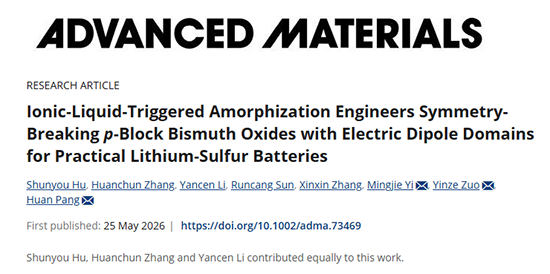
近日,大连工业大学(青拔&青托)胡顺友、莆田学院的易明杰教授、福州大学的左银泽老师、扬州大学的庞欢教授,针对锂硫电池中硫氧化还原动力学迟缓、多硫化锂(LiPSs)穿梭效应严重制约实际应用的关键难题,提出一种利用铁基离子液体诱导非晶化的策略,通过在碳纳米纤维(CNFs)上构建具有电偶极域和不对称Fe1-O-Bi电子桥(Fe1⊂A/C-Bi2O3@CNFs)的对称性破缺p区氧化铋。非晶相引发显著电子离域,促进轨道大幅重叠并形成电子传输通道,从而加速多硫化锂的氧化还原。特别地,不对称Fe1-O-Bi电子桥通过3d-2p-6p多轨道耦合降低p带中心,优化多硫化锂的化学吸附并防止活性位点中毒。电子偶极域作为电子/Li+“泵”增强电荷转移和Li+扩散。此外,电偶极域诱导偶极-偶极相互作用,促进Li-S键极化与断裂。基于Fe1⊂A/C-Bi2O3的电池在1.0 C倍率下循环1000次后仍保持698 mAh g-1的容量,单圈衰减率仅为0.026%;在7.4 mg cm-2硫载量下获得6.8 mAh cm-1的高面容量。这种通过非晶化构建电子偶极域的策略,为硫氧化还原反应高效催化剂的理性设计提供了新思路。
该成果以大连工业大学学院为第一单位以题目“Lonic-Liquid-Triggered Amorphization Engineers Symmetry-Breaking p-Block Bismuth Oxides with Electric Dipole Domains for Practical Lithium-Sulfur Batteries”在国际顶级期刊Advanced materials(中科院一区)上发表,影响因子为26.8。
三、核心创新点
该研究核心创新点在于提出离子液体诱导非晶化,构建电偶极畴的多策略协同优化方案,同步解决锂硫电池硫氧化还原动力学迟缓和多硫化锂穿梭效应两大关键瓶颈。通过整合非晶化工程(打破晶体长程有序)、对称性破缺结构(构建电偶极畴)及不对称Fe₁-O-Bi电子桥设计,协同提升材料电子离域程度、电荷传输效率与多硫化锂转化动力学。借助原位表征与DFT计算,从原子层面阐明了电偶极畴、多轨道耦合与Li-S键活化的协同催化机制。所设计催化剂显著提升硫氧化还原动力学、抑制穿梭效应,实现长循环、高硫负载与实用化软包电池,为高性能锂硫电池催化剂设计提供新颖范式。
四、数据概览
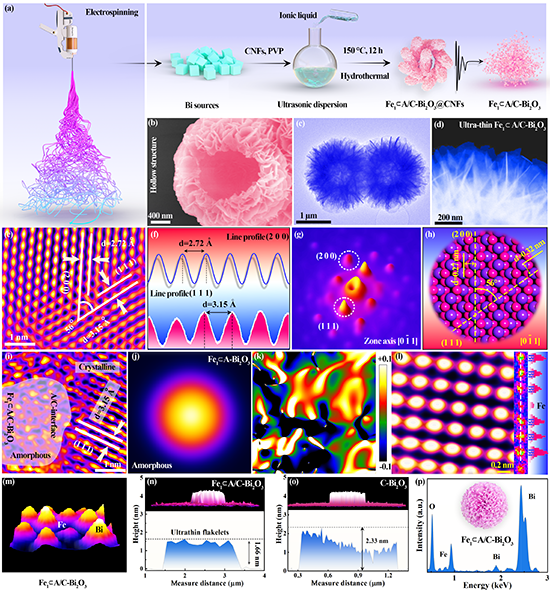
Fig. 1. (a) Schematic illustration of the Fe1⊂A/C-Bi2O3@CNFs. (b) SEM and (c, d) TEM images of Fe1⊂A/C-Bi2O3. (e) HRTEM images, corresponding (f) lattice spacing profiles, (g) fast-Fourier-transform images, and (h) crystal plane structures of C-Bi2O3. (i) HRTEM images, (j) corresponding fast-Fourier-transform images, and (k) geometric phase analysis of Fe1⊂A/C-Bi2O3. (l) Spherical aberration-corrected HAADF-STEM images and (m) corresponding 3D topographic atom images of Fe1⊂A/C-Bi2O3. AFM images and corresponding height profiles of (n) Fe1⊂A/C-Bi2O3 and (o) C-Bi2O3. (p) Elemental distribution of Fe1⊂A/C-Bi2O3.
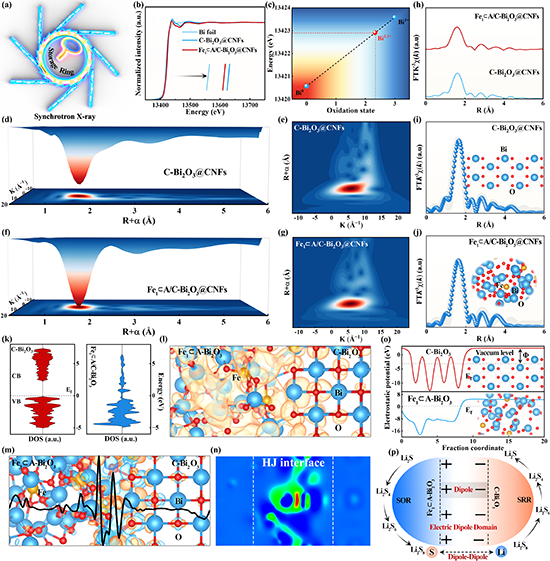
Fig. 2. (a) Diagram of Synchrotron Radiation. (b) Bi L3-edge XANES spectra. (c) Linear relationship between L3-edge absorption energy and oxidation state. WT contour plots of C-Bi2O3@CNFs (d, e) and Fe1⊂A/C-Bi2O3@CNFs (f, g). FT-EXAFS spectra (h) and the corresponding fitting result for C-Bi2O3@CNFs (i) and Fe1⊂A/C-Bi2O3@CNFs (j). (k) The total DOS diagrams of Fe1⊂A/C-Bi2O3@CNFs and C-Bi2O3@CNFs. (l, m, n) The calculated charge density differences of Fe1⊂A/C-Bi2O3@CNFs. (o) Calculated electrostatic potentials of C-Bi2O3@CNFs and Fe1⊂A/C-Bi2O3@CNFs. (p) The diagram of electric dipole domains within Fe1⊂A/C-Bi2O3
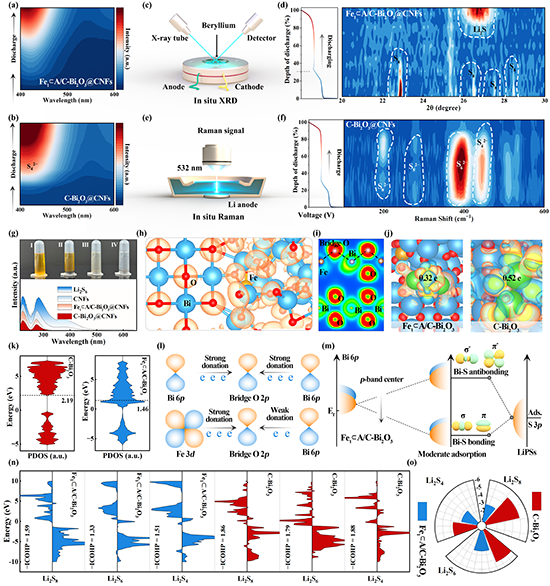
Fig. 3. Contour maps of in situ UV-vis spectra of the cells with (a) Fe1⊂A/C-Bi2O3@CNFs and (b) C-Bi2O3@CNFs. (c) Schematic diagram of the in situ XRD setup and corresponding (d) contour maps. (e) Schematic diagram of the in situ Raman setup and corresponding (f) contour maps. (g) UV absorbance spectra of the Li2S6 solutions. (h, i) ELF of Fe1⊂A/C-Bi2O3. (j) The difference charge density of Li2S6 adsorbed on Fe1⊂A/C-Bi2O3 and C-Bi2O3. (k) The PDOS of Bi-6p orbitals. (l) Schematic illustrations of the electronic interactions among orbitals. (m) Scheme for energy level splitting of Bi-6p orbitals and S-3p orbitals. (n) COHP for Bi-S coupling between LiPSs and Bi-based catalysts. (o) Adsorption energy between LiPSs and catalysts.
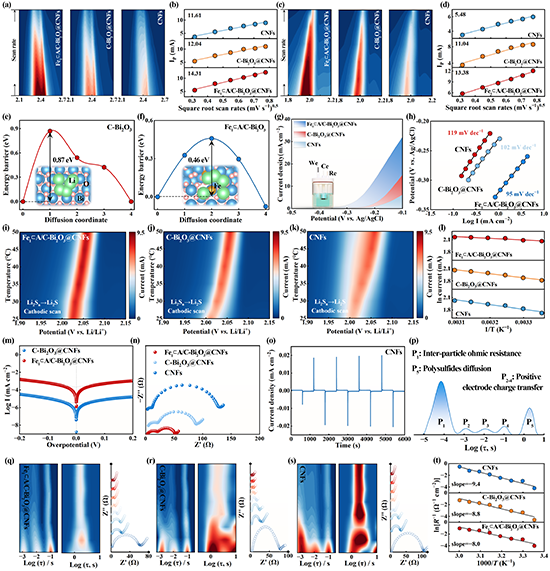
Fig. 4. Contour plots of (a) peak A and (c) peak C from the CV curves of Li||S batteries. The linear relationships between Ip and the square root of scan rates for (b) peak A and (d) peak C. The energy barrier for the diffusion process of Li+ within (e) C-Bi2O3 and (f) Fe1⊂A/C-Bi2O3. (g) LSV curves and corresponding (h) Tafel plots. Contour plots of CV patterns for (i) Fe1⊂A/C-Bi2O3@CNFs, (j) C-Bi2O3@CNFs, and (k) CNFs at different temperatures. (l) The linear relationship between ln (Ip) and 1/T. (m) Tafel plots, (n) EIS plots, and (o) chronoamperometric curves for the symmetric cells. (p) DRT curves of the Li||S battery. EIS plots and corresponding DRT contour plots at different temperatures for (q) Fe1⊂A/C-Bi2O3@CNFs, (r) C-Bi2O3@CNFs, and (s) CNFs-based cells. (t) The linear relationship between the ln(1/R) and the 1/T.
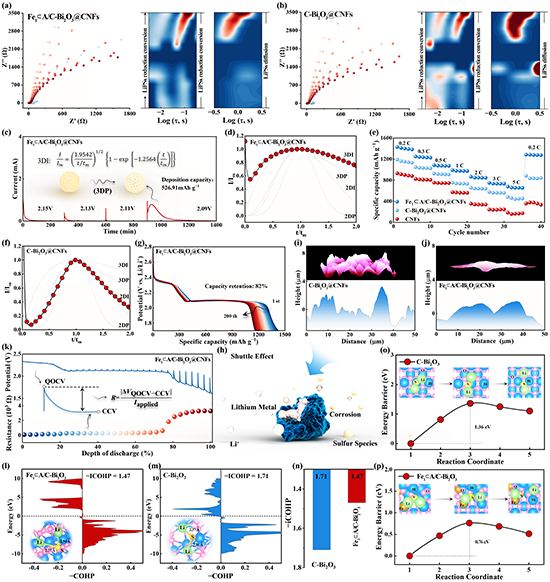
Fig. 5. (a, b) In situ EIS and the corresponding DRT contour of Li||S cells during the discharging process. (c) Kinetic assessment using PITT measurement. (d, f) Dimensionless current-time transient profile during the deposition of Li2S. (e) Rate performance of the Li||S batteries. (g) Galvanostatic discharge profiles of Fe1⊂A/C-Bi2O3@CNFs-based cell. (h) Diagram of lithium metal corrosion caused by the shuttle effect of LiPSs. (i, j) AFM images of lithium anode after cycling. (k) GITT curves of Fe1⊂A/C-Bi2O3@CNFs-based cells. (l, m, n) COHP of Li-S coupling in Li2S. (o, p) Energy barrier of Li2S decomposition.
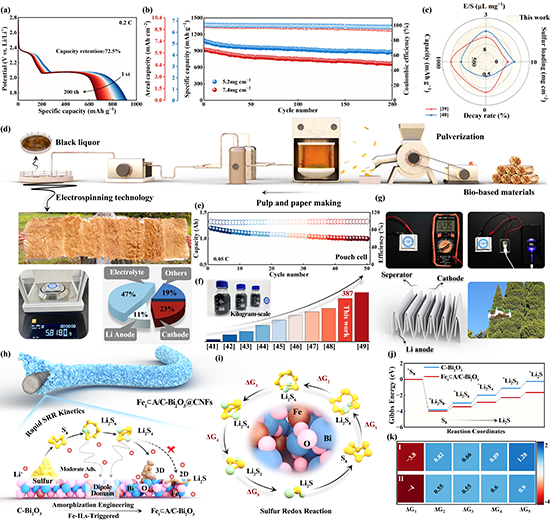
Fig. 6. (a) Discharge profiles and (b) cycling performance of Fe1⊂A/C-Bi2O3@CNFs-based cells with high sulfur loadings. (c) Performance comparisons of Li||S batteries with recent references. (d) Fabrication process of the Fe1⊂A/C-Bi2O3@CNFs-based pouch cell. (e) Cycling performance of Li||S pouch cell. (f) Performance comparison of the Fe1⊂A/C-Bi2O3@CNFs-based pouch cell with recent literature. (g) Practical utilization of the Fe1⊂A/C-Bi2O3@CNFs-based pouch cell. (h) Schematic illustration of the enhanced SRR kinetics mediated by the Fe1⊂A/C-Bi2O3. (i−k) Gibbs free energy for SRR.
五、成果启示
该研究的成果启示主要体现在四方面。其一,非晶化与晶态/非晶异质界面耦合可构建强内建电场和电偶极畴,为改善硫氧化还原动力学、抑制多硫化锂穿梭效应提供了通用新策略。其二,不对称Fe₁-O-Bi电子桥与多轨道耦合可精准调控p带中心,实现多硫化锂温和吸附与高效转化,为p区金属催化剂的电子结构调控提供了新思路。其三,原位表征与理论计算结合,可从原子层面揭示催化机制,为硫正极催化剂的机理研究与结构设计建立了规范方法。其四,本工作实现高硫负载、长循环稳定与实用化软包电池,证明非晶化与电偶极畴设计可有效推动锂硫电池实用化,为高比能储能器件发展开辟了新路径。